Area of a Rhombus Formula
Geometry Formulas: Area, Volume, Perimeter
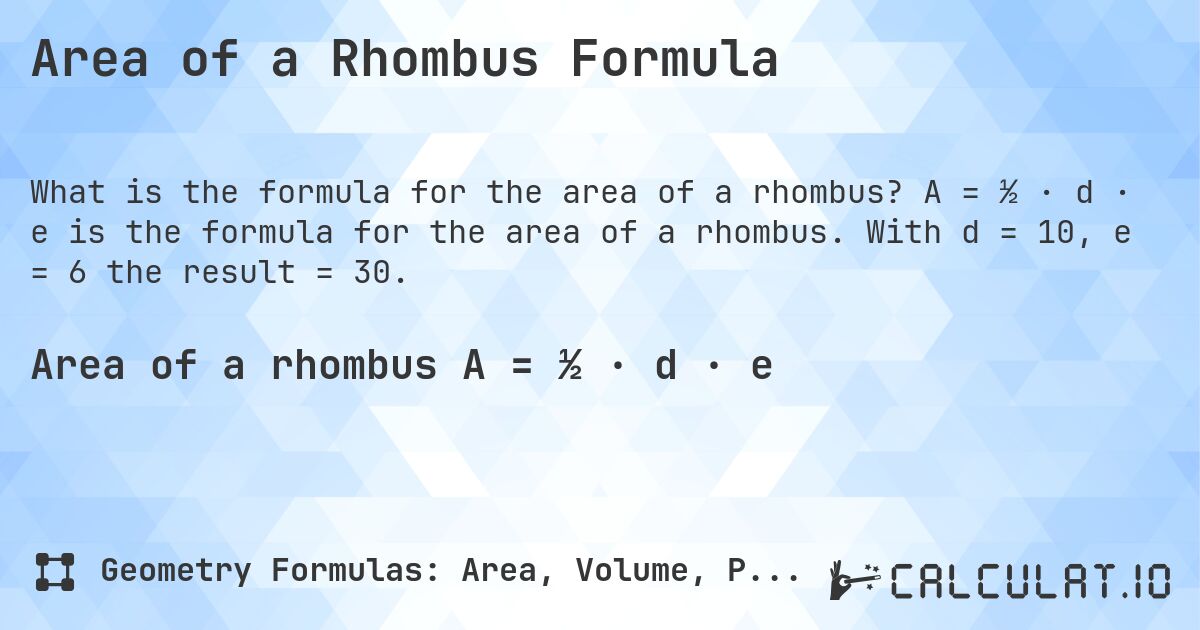
What is the formula for the area of a rhombus?
Answer
Area of a rhombus
A = ½ · d · e
d — the first diagonal; e — the second diagonal. Result in square units.
Example
d = 10, e = 6
A = ½ · 10 · 6
= ½ · 60
= 30 square units
Where the formula comes from
The diagonals of a rhombus cross at right angles and cut each other in half, so they slice it into four right triangles. Put together, those four fill exactly half of the rectangle d by e drawn around the rhombus.
Another example
d = 7.4, e = 5
A = ½ · 7.4 · 5
= ½ · 37
= 18.5 square units
The common mistake
Squaring the side, as for a square. A rhombus has four equal sides, but unless it IS a square its angles are not right, and then a² overstates the area — the same trap as with a parallelogram, which a rhombus is. A square is the one rhombus where a² happens to be exact.
Next
Found an error in the calculation or the information?
Related Calculations
See Also
- Square Footage Calculator - Width × length in feet to square feet
- Square Feet to Square Meters (Sq Ft to Sq M) - Convert Square Feet to Square Meters
- Square Meters to Square Feet (Sq M to Sq Ft) - Convert Square Meters to Square Feet
- Gravel Calculator - Area to cubic yards, tons and coverage
- Topsoil Calculator - Cubic yards, weight and coverage for any area
- Multiplication Facts - Any two numbers from 1 to 9, with the working shown
Share This Calculation
Print
 <a href="https://calculat.io/en/geometry/shape-formula/area--rhombus">Area of a Rhombus Formula - Calculatio</a>
Facebook
Twitter
Telegram
WhatsApp
Viber
Email
Values from the Formula (e = 6)
| If d = | Area |
|---|---|
| 1 | 3 square units |
| 2 | 6 square units |
| 3 | 9 square units |
| 4 | 12 square units |
| 5 | 15 square units |
| 10 | 30 square units |