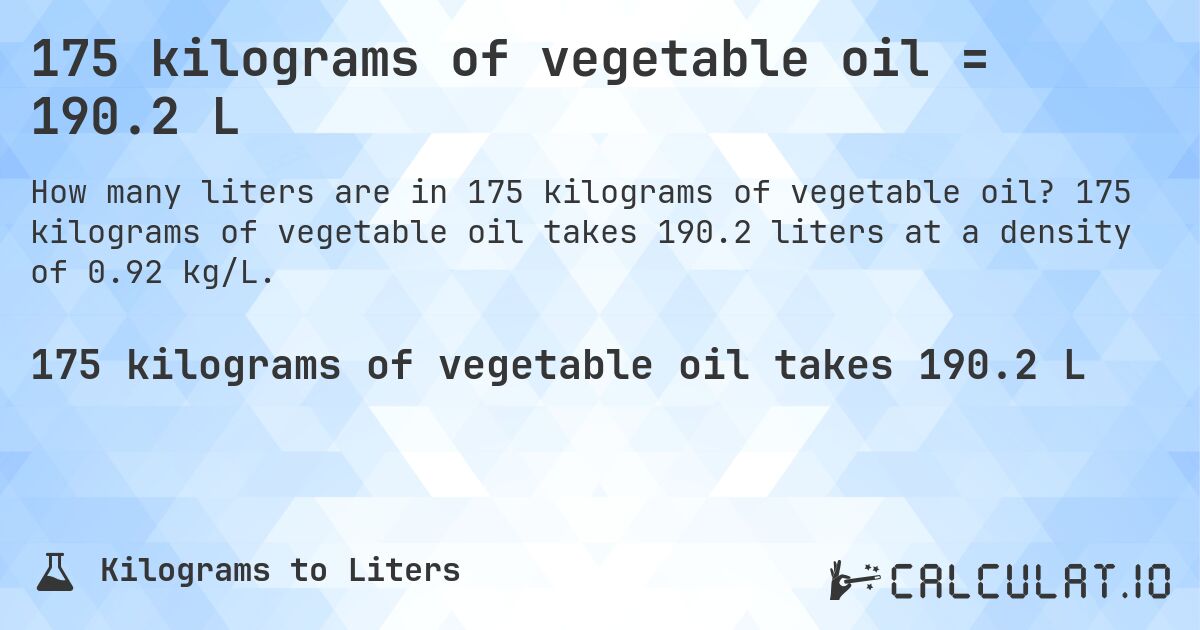
How many liters are in 175 kilograms of vegetable oil?
"Kilograms to Liters" Calculator
How many liters are in 175 kilograms of vegetable oil?
Answer
175 kilograms of vegetable oil takes
190.2 L
The density of vegetable oil is 0.92 kg/L (at 15.6–20 °C; peanut 0.914, olive 0.918, corn 0.922, soybean 0.927).
How the volume of 175 kilograms of vegetable oil was worked out
volume = mass ÷ density
175 kg ÷ 0.92 kg/L
≈190.2 L
The density comes from FAO/INFOODS Density Database v2.0. At 15.6–20 °C; peanut 0.914, olive 0.918, corn 0.922, soybean 0.927.
The other way round: what a liter of this weighs
This page starts from a mass and answers in liters. The opposite question — how much a given volume weighs — is what the liters to kilograms calculator is for. Both read the same density table, so the two pages agree wherever the answer is volume times density.
For vegetable oil the density is 0.92 kg/L, so 175 kilograms takes 190.2 liters — and one liter of it weighs 0.92 kg.
Found an error in the calculation or the information?
Related Calculations
See Also
- Liters to Kilograms - How many kilograms are in a liter of water, honey, gasoline, sand and other substances — by density
- Pounds to Liters - How many liters a pound of water, milk, oil or propane takes — by density
- Pounds to Gallons - How many gallons a pound of water, milk, oil or propane takes — by density
- L to Ml - Convert Liters to Milliliters
- Ml to L - Convert Milliliters to Liters
- Liters to Gallons - Convert Liters to US Gallons
Share This Calculation
Print
 <a href="https://calculat.io/en/volume/kg-to-l/175--vegetable-oil">175 kilograms of vegetable oil = 190.2 L - Calculatio</a>
Facebook
Twitter
Telegram
WhatsApp
Viber
Email
How much room 175 kilograms of each substance takes
| Substance | Volume | Density, kg/L |
|---|---|---|
| Cement | 125–140 L | 1.25–1.4 |
| Diesel | 209.8 L | 0.834 |
| Gasoline | 236.5 L | 0.74 |
| Honey | 123.2 L | 1.42 |
| LPG | 343.1 L | 0.51 |
| Milk | 169.9 L | 1.03 |
| Mineral spirits | 224.4 L | 0.78 |
| Motor oil | 205.9 L | 0.85 |
| Sand | 87.5–106.1 L | 1.65–2 |
| Sugar | 194.4–243.1 L | 0.72–0.9 |
| Tomatoes | 291.7–318.2 L | 0.55–0.6 |
| Vegetable oil | 190.2 L | 0.92 |
| Wall primer | 175 L | 1 |
| Water | 175.4 L | 0.998 |
About "Kilograms to Liters" Calculator
This calculator converts kilograms to liters through the density of the substance: volume equals mass divided by density. The heavier the substance, the less room the same kilogram takes — one kilogram of honey is 0.7 liters, while one kilogram of liquefied gas is almost two. For example, it can help you find out how many liters are in 175 kilograms of vegetable oil? (The answer is: 190.2). For bulk materials the answer is a range, and it is inverted against the weight page: the denser the packing, the smaller the volume of the same mass.