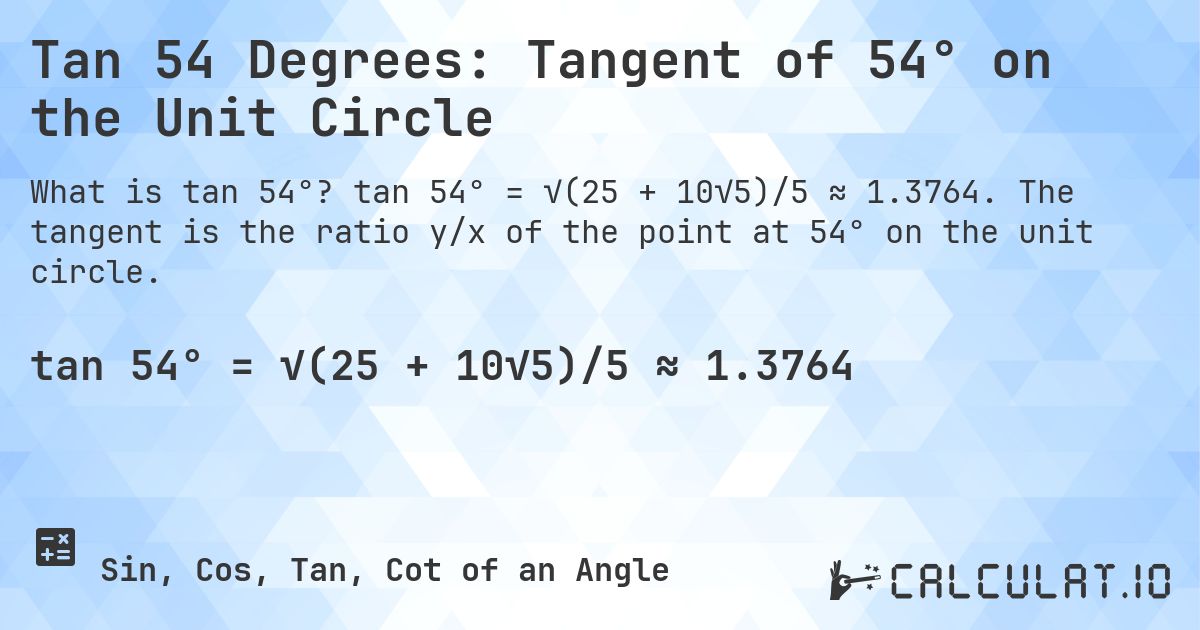
Tan 54 Degrees
Sin, Cos, Tan, Cot of an Angle
What is tan 54°?
Answer
tan 54° =
√(25 + 10√5)/5 ≈ 1.3764
Angle in radians: 54° = 3π/10. The point of the angle is in quadrant I, where tangent is positive.
≈ — rounded to 4 decimal places.
tan 54° = sin 54° / cos 54° = ((√5 + 1)/4) / (√(10 − 2√5)/4) = √(25 + 10√5)/5
Regular pentagon (golden ratio): cos 36° = (√5 + 1)/4.
tan 54° = cot 36° = cos 36° / sin 36° = √(25 + 10√5)/5
P(cos 54°, sin 54°) ≈ (0.5878, 0.8090)
T(1, tan 54°) ≈ (1, 1.3764) — where line OP meets the line x = 1.
| Function | Exact value | Decimal |
|---|---|---|
| sin 54° | (√5 + 1)/4 | ≈ 0.8090 |
| cos 54° | √(10 − 2√5)/4 | ≈ 0.5878 |
| tan 54° | √(25 + 10√5)/5 | ≈ 1.3764 |
| cot 54° | √(5 − 2√5) | ≈ 0.7265 |
Found an error in the calculation or the information?
See Also
- Arcsin, Arccos, Arctan, Arccot - The angle from the value of its sine, cosine, tangent or cotangent: exact in degrees and π, with the check and the unit circle
- Square Root Calculator - Calculate the square root of any number
- Simplify Square Root Calculator - Write any square root in simplest radical form, step by step
- Geometry Formulas: Area, Volume, Perimeter - The formula for every standard shape, where it comes from, and worked examples
Share This Calculation
Print
 <a href="https://calculat.io/en/number/trigonometry/tan--54">Tan 54 Degrees: Tangent of 54° on the Unit Circle</a>
Facebook
Twitter
Telegram
WhatsApp
Viber
Email