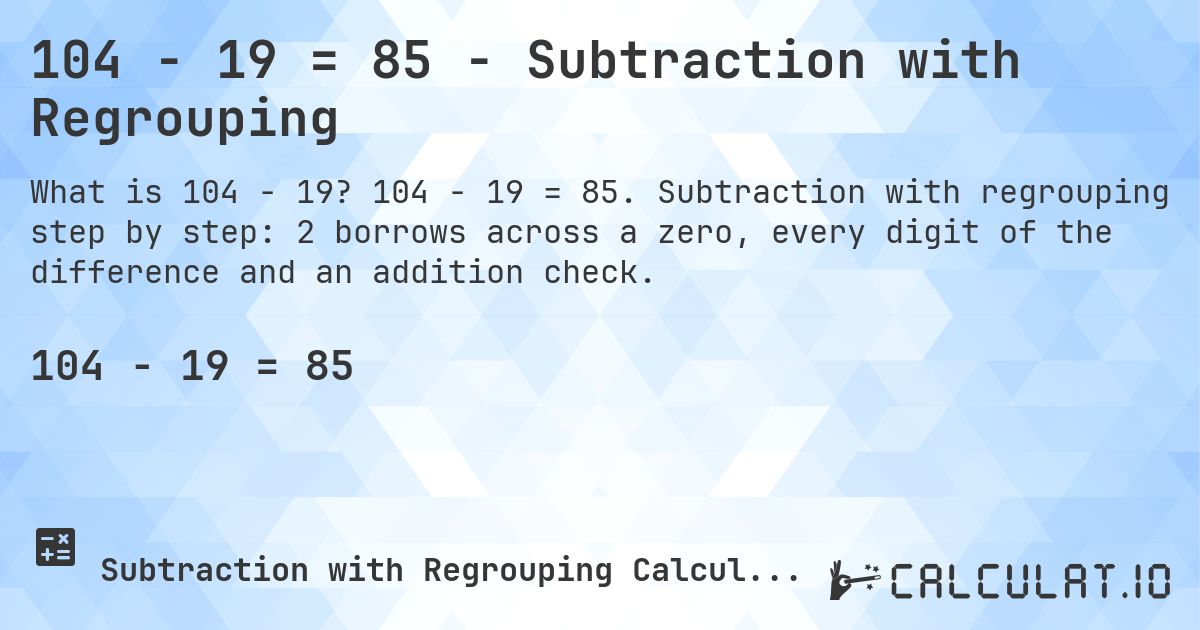
Subtraction with Regrouping: 104 − 19
Subtraction with Regrouping Calculator
What is 104 − 19?
Answer
104 − 19 =
85
With regrouping across a zero: 2 borrows — there are no tens to borrow from, so 1 hundred becomes 10 tens, and 1 ten goes to the ones
| 0 | 9 | +10 | |
| 4 (was 4, now 14) | |||
| − | 1 | 9 | |
| 8 | 5 |
Column by column: 104 − 19
- Ones: 4 is less than 9 — borrow 1 hundred across the zero: hundreds 1 → 0, tens 0 → 9; 14 − 9 = 5 — write 5.
- Tens: after borrowing, 9; 9 − 1 = 8 — write 8.
- Hundreds: after borrowing, 0 — a leading zero is not written.
104 − 19 = 85
Second check: 104 − 85 = 19
Similar examples to practise
Found an error in the calculation or the information?
Related Calculations
See Also
- Addition with Regrouping Calculator - Column addition step by step, with every carry
- Long Division Calculator - Step-by-step long division with detailed explanation
- Long Multiplication Calculator - Column multiplication with partial products, step by step
- Subtracting Fractions Calculator - Subtract fractions, mixed numbers and whole numbers step by step
Share This Calculation
Print
 <a href="https://calculat.io/en/number/long-subtraction/104--19">104 − 19 = 85 - Subtraction with Regrouping - Calculatio</a>
Facebook
Twitter
Telegram
WhatsApp
Viber
Email