Arccot of −√3/3
Arcsin, Arccos, Arctan, Arccot
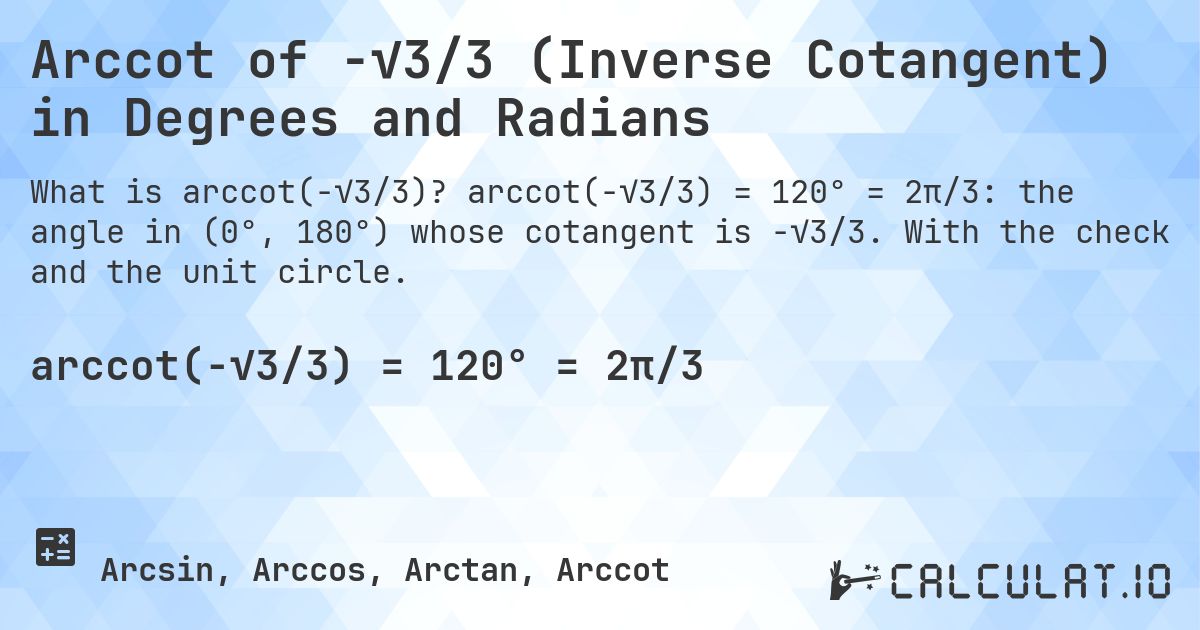
What is arccot(−√3/3)?
Answer
arccot(−√3/3) =
120° = 2π/3
Range: arccot x is an angle strictly between 0° and 180°, so the answer is unique.
arccot(−√3/3) is the angle α in (0°, 180°) with cot α = −√3/3.
arccot(−√3/3) = 180° − arccot(√3/3) = 180° − 60° = 120°
α = arccot(−√3/3) = 120°
P(cos 120°, sin 120°) = (−1/2, √3/2)
C(−√3/3, 1) is where line OP meets the line y = 1; highlighted: cot α = −√3/3.
| Function | Degrees | Radians |
|---|---|---|
| arcsin(−√3/3) | ≈ −35.2644° | ≈ −0.6155 |
| arccos(−√3/3) | ≈ 125.2644° | ≈ 2.1863 |
| arctan(−√3/3) | −30° | −π/6 |
| arccot(−√3/3) | 120° | 2π/3 |
Found an error in the calculation or the information?
See Also
- Sin, Cos, Tan, Cot of an Angle - Exact value in square roots and the decimal, with reduction to an acute angle on the unit circle
- Square Root Calculator - Calculate the square root of any number
- Simplify Square Root Calculator - Write any square root in simplest radical form, step by step
Share This Calculation
Print
 <a href="https://calculat.io/en/number/inverse-trigonometry/arccot---sqrt3-3">Arccot of −√3/3 (Inverse Cotangent) in Degrees and Radians</a>
Facebook
Twitter
Telegram
WhatsApp
Viber
Email
Arccotangent of nearby values
| x | arccot x |
|---|---|
| −2 | ≈ 153.4349° |
| −√3 | 150° = 5π/6 |
| −1 | 135° = 3π/4 |
| −√3/3 | 120° = 2π/3 |
| 0 | 90° = π/2 |
| 0.3 | ≈ 73.3008° |
| 1/2 | ≈ 63.4349° |