What is 5/8 divided by 10?
What is 5/8 divided by 10?
Answer
As a decimal: 0.0625
1/16 is the result of dividing 5/8 by 10.
Steps to divide 5/8 by 10
Dividing by a fraction is the same as multiplying by its reciprocal, so 5/8 ÷ 10 is solved by turning the divisor upside down and multiplying. Here is every step.
Step 1: Write both numbers as fractions
A whole number is written over 1, and a mixed number becomes an improper fraction: multiply the whole part by the denominator and add the numerator.
10 = 10/1
Step 2: Flip the divisor
The reciprocal of 10/1 is 1/10, because a fraction and its reciprocal multiply to 1. Division by 10/1 therefore becomes multiplication by 1/10.
Step 3: Multiply across
Multiply the numerators together and the denominators together.
5/8 × 1/10
=(5 × 1)/(8 × 10)
=5/80
Step 4: Reduce the fraction
The greatest common factor of 5 and 80 is 5, so divide both parts by it.
5/80
=1/16
Answer
5/8 ÷ 10
=1/16
As a decimal, 5/8 ÷ 10 = 0.0625.
Related Calculations
See Also
- Adding Fractions Calculator - Add fractions, mixed numbers and whole numbers step by step
- Fraction to Decimal Converter - Convert Fraction to Decimal
- Fraction Comparison Calculator - Compare two fractions and find out which is larger
- Fraction to Mixed Number Converter - Convert an Improper Fraction to a Mixed Number
- Multiplying Fractions Calculator - Multiply fractions, mixed numbers and whole numbers step by step
- Fraction Simplifier Calculator - Simplify Fraction to its Lowest Terms
- Subtracting Fractions Calculator - Subtract fractions, mixed numbers and whole numbers step by step
- Percent to Fraction Converter - Convert Percents to Fractions
 <a href="https://calculat.io/en/number/fraction-division/0--5--8--10--0--1">5/8 divided by 10 = 1/16 - Calculatio</a>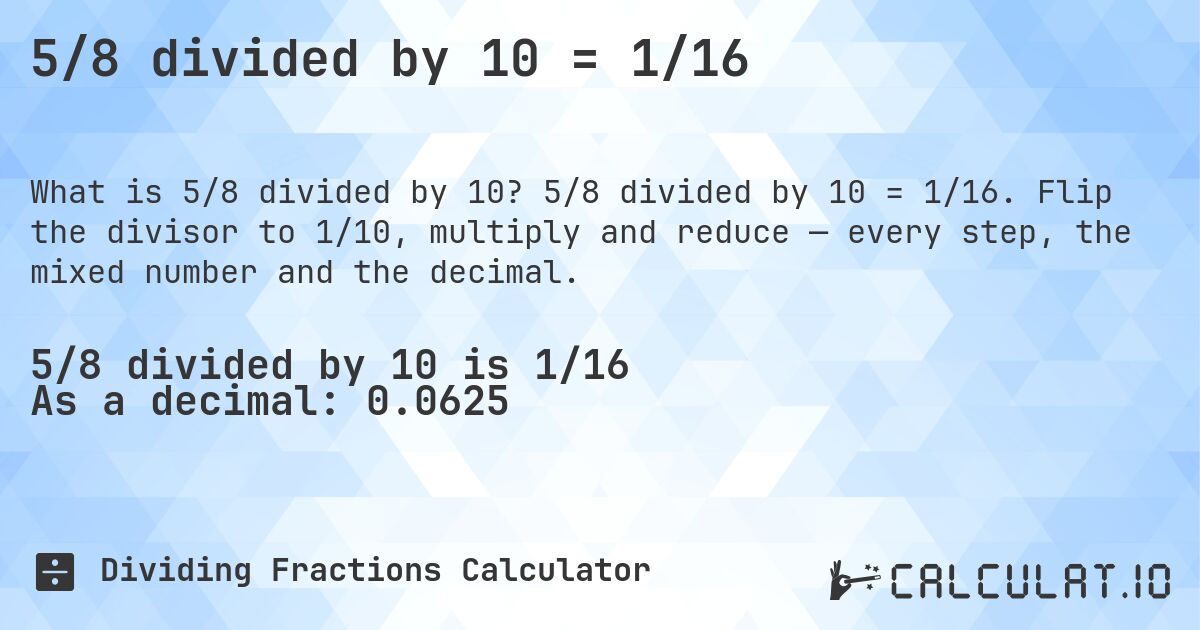
Fraction Division Table
Dividing Fractions Calculator
This calculator divides one fraction by another and shows the whole solution, not just the answer. Mixed numbers and whole numbers are accepted on both sides, so you can divide 2 3/4 by 2/3 just as easily as 1/2 by 4.
For example, it can help you find out what is 5/8 divided by 10? (The answer is: 1/16).
Enter the dividend on the left and the divisor on the right (for example '5/8' and '10'), then press the button.
The result is given as a fraction in its lowest terms, as a mixed number when it is greater than one, and as a decimal — with an approximation sign whenever the decimal never ends.
Every page also shows why the method works: dividing by a fraction is the same as multiplying by its reciprocal, so the divisor is flipped and the two fractions are multiplied.