Convert 23 m/s to mph
"Meters per Second to Miles per Hour" Calculator
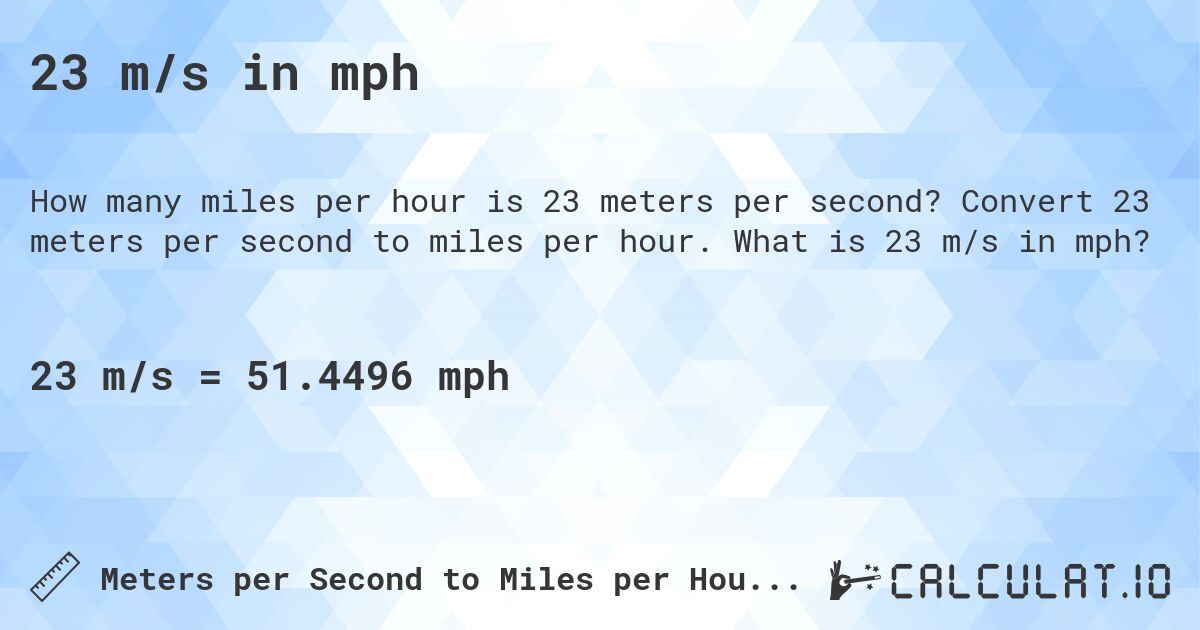
How many miles per hour is 23 meters per second?
Answer
23 m/s ≈ 51.4495 mph
23 m/s ÷ 0.44704 ≈ 51.4495 mph
Found an error in the calculation or the information?
See Also
- Miles per Hour to Kilometers per Hour - Convert Miles per Hour to Kilometers per Hour
- Kilometers per Hour to Miles per Hour - Convert Kilometers per Hour to Miles per Hour
- M/S to KM/H - Convert M/S to KM/H
- KM/H to M/S - Convert KM/H to M/S
- Knots to Km/h - Convert Knots to Km/h
- Km/h to Knots - Convert Km/h to Knots
- Miles per Hour to Meters per Second - Convert Miles per Hour to Meters per Second
Share This Calculation
Print
 <a href="https://calculat.io/en/length/ms-to-mph/23-ms">23 m/s in mph - Calculatio</a>
Facebook
Twitter
Telegram
WhatsApp
Viber
Email
Meters per Second to Miles per Hour Conversion Table
| Meters per Second | Miles per Hour |
|---|---|
| 9 m/s | 20.1324 mph |
| 10 m/s | 22.3694 mph |
| 11 m/s | 24.6063 mph |
| 12 m/s | 26.8432 mph |
| 13 m/s | 29.0802 mph |
| 14 m/s | 31.3171 mph |
| 15 m/s | 33.554 mph |
| 16 m/s | 35.791 mph |
| 17 m/s | 38.0279 mph |
| 18 m/s | 40.2649 mph |
| 19 m/s | 42.5018 mph |
| 20 m/s | 44.7387 mph |
| 21 m/s | 46.9757 mph |
| 22 m/s | 49.2126 mph |
| 22.35 m/s | 49.9955 mph |
| 23 m/s | 51.4495 mph |
| 24 m/s | 53.6865 mph |
| 25 m/s | 55.9234 mph |
| 26 m/s | 58.1603 mph |
| 27 m/s | 60.3973 mph |
| 28 m/s | 62.6342 mph |
| 29 m/s | 64.8712 mph |
| 30 m/s | 67.1081 mph |
| 35 m/s | 78.2928 mph |
| 38 m/s | 85.0036 mph |
| 40 m/s | 89.4775 mph |
| 44.7 m/s | 99.9911 mph |
| 45 m/s | 100.6621 mph |
| 50 m/s | 111.8468 mph |
| 55 m/s | 123.0315 mph |